

What is stored, and where
- In the database
- On the machine
- In git
How long it stays
Short version: chats, runs and their events are kept until you delete them. There are exactly two scheduled sweeps on the platform, and neither touches anything you wrote:
No job deletes a chat, a message, a run or a usage row on a schedule. Nothing
expires on its own. If you want a conversation gone, delete it; if you want all
of it gone, delete the account.
The API’s event journal can answer
410 event_cursor_expired for a stream cursor
that points before the retained window. It is part of the streaming contract —
resume without a cursor and you get the whole run — and not a statement that the
run’s events have been removed.Who can see it
You, through the app and the API, with your session or an API key. Anyone holding a share link. A shared chat is a public URL with no sign-in: the token is the access control. Making the chat private kills the link immediately, and sharing it again mints a different one. Security has the detail. The model provider behind the run. The text of a turn, its attachments and the tool results in its context go to whichever endpoint the run resolved to — Splox’s account with that provider on a platform endpoint, or your own account on a connection you added. Before the first time this happens, the app asks:Allow Splox to send your inputs to AI providers To generate responses and run agents, Splox sends your messages, attachments, files, prompts, agent context, and related inputs to third-party AI providers such as OpenAI, Anthropic, and Google, and to tool integrations you enable.Declining means the message is not sent and the action does not proceed. Servers you connect. A tool call sends what that call needs to the MCP server it belongs to, with the credential you connected it with. Nobody else. A chat, a machine and a harness are yours; another account’s request for one of them answers
404 rather than 403, because telling a
prober that something exists is itself an answer.
The privacy policy is where the sub-processors are named and where the transfer
basis for processing outside the EEA is set out. Read it if any of that decides
whether you can put a piece of work here. It makes no statement about your data
being used to train models — do not assume one in either direction; ask
support if it matters to your case.
Analytics and cookies
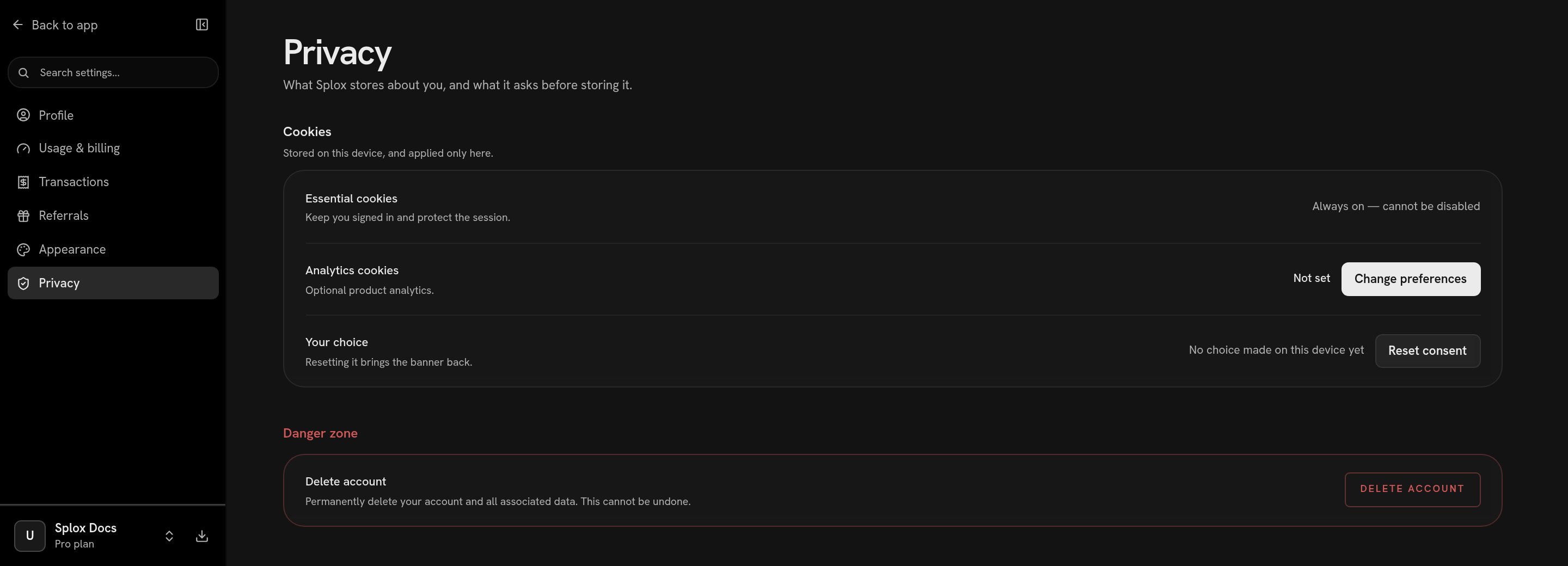
Settings → Privacy: what is stored about you, and the one way to have none of it stored
Getting your data out
There is no export button. What there is:- A chat — the transcript is on
GET /api/v1/chat-history/{chat_id}/paginated. - Runs — the v2 API returns a run’s messages, outputs, events, usage and its tree of sub-agent runs.
- The harness —
git clonethe repository; it is an ordinary git remote and the history comes with it. See Publishing a version. - Files on the machine — the agent can hand you any of them as a download link, or push a whole directory to a git remote you can clone.
Deleting
Deleting a chat removes it from the product: it stops being listed, it 404s for you, and its share link 404s for everyone. The row is marked deleted rather than erased. Deleting a machine destroys the sandbox and its disk. Deleting a harness destroys the repository and every machine running it. Deleting the account is the erasure. Settings → Privacy → Delete account, confirmed by typing the phrase:This permanently deletes your account and all associated data — harnesses, agents, chats, credentials and billing history. Any active subscription is cancelled immediately.Every sandbox you own is destroyed, Stripe is told to cancel and to delete the customer, and one database transaction removes the rows: chats, messages, tool-call records, runs and their events, machines, MCP servers, skills, push tokens, webhooks, sessions, identities, balances, transactions, subscriptions and usage. It is not reversible and there is no grace period. Two things are kept on purpose: the consent log, with your user id set to null, as the evidence that consent was asked for; and the git repositories, whose history has never been removed by deleting a user’s rows. To exercise a GDPR right that this page does not cover — access, rectification, portability, restriction, objection — the policy names
[email protected] and
undertakes to answer within 30 days.
Security
Where the work happens and what can reach it.
Privacy policy
The legal document, with the sub-processors named.