

id, its sort_order and the Stripe price
ids checkout uses.
Money is in microdollars everywhere in this API: 1,000,000 µ25.
The four
Max and Max 20x are one card in the app with a 5× / 20× toggle on it.
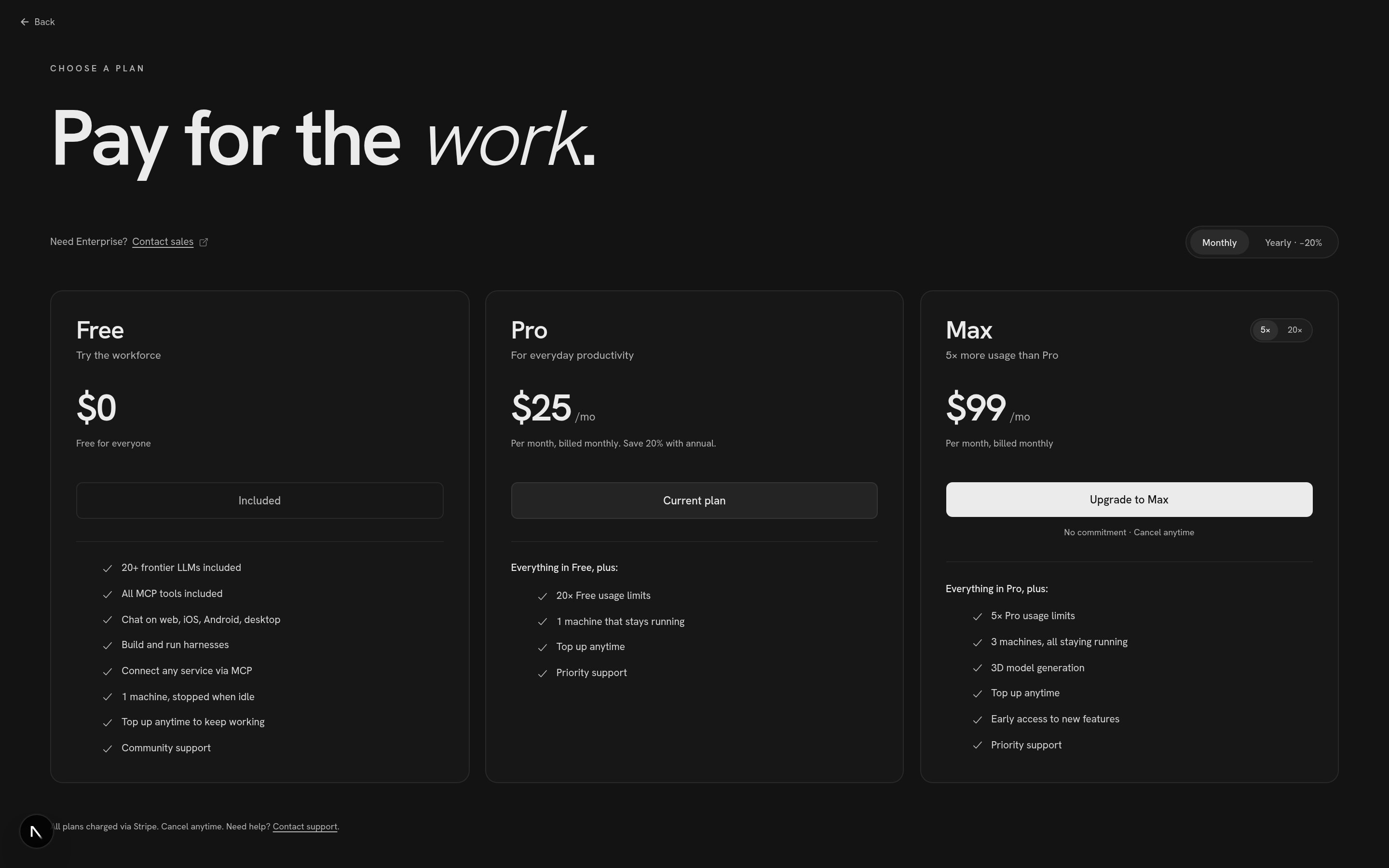
The plan grid: price, what the tier adds, and the machines it runs
What a plan governs
Pace
Every plan holds two rolling windows, five hours and a week, and the plan sets the cap on each. A bigger plan is a bigger cap, not a different product: the same models, the same tools, more of them per window. The caps themselves are not published — the plans endpoint deliberately omits them, and the app’s pricing cards compare tiers in multiples rather than in units. What you read instead is how full yours is, as a percentage, on Usage.Machines
machine_limit is how many machines the account keeps, counted over the ones
you have not deleted. machines_persistent is whether they stay up.
A machine on a paid plan has no idle timeout: it runs until somebody stops it.
A free machine stops after 30 minutes with nothing touching it, which is the
line that decides whether a long-running program — a Telegram bot, a watcher, a
nightly job — is something you can actually run. Either way the disk survives:
stopping is not deleting. See Machine.
Asking for a machine past the limit is refused before anything is created:
402, not a 429, and the code is deliberately not out_of_funds:
nothing resets on its own here and a full wallet buys no extra machines. Only a
different plan does.
Features that cost per call
3D model generation runs on Max and Max 20x:media_generate_3d, media_rig_3d
and the media_job poll that goes with them. A mesh is minutes of GPU time, so
it is part of what a Max subscription buys rather than something every run can
reach for. On any other plan the tool answers 3D generation is available on the Max plan.
Two more things need a paid plan, and both are refusals a free account meets
rather than features it sees:
- Top-ups. The wallet that funds extra usage can
only be filled on Pro or Max. A free account gets
topup_requires_subscription. - API tokens. Minting a key for the API needs a paid plan. See API keys.
What a plan does not govern
Models. Every plan reaches every model the platform offers, and the free plan is not restricted to a cheap one. What differs is how much of a window a call consumes, and an expensive model consumes more of it. See Model. Tools and MCP servers. All of them, on every plan. Your own provider keys. A call made on a connection you added yourself is paid to your provider, not to us: it is not priced, it is not written to the ledger, and it does not fill a window.Changing plans
The pricing page and the Manage button on Usage & billing both end at Stripe. Which one you get depends on whether you already pay for something — first subscription goes to Checkout, a change of plan or interval goes to the Customer Portal. Billing has the endpoints and what each answer means.Usage
The two windows, and how to read the bars.
When a window fills
The refusal, the wait, and what does not lift it.
Extra usage
The wallet that pays past a full window.
Billing
Subscribing, invoices, canceling, and what a downgrade does.