

integer
The balance, in microdollars. 1,000,000 µ$ is one dollar.
boolean
Whether the wallet holds anything. There is no switch to flip: extra usage is
on whenever there is money in it, and the screen says “Extra usage is on.” or
“Extra usage is off.” accordingly.
integer
Wallet debits for extra-funded calls in the current billing period — the
subscription’s own period,
current_period_start to current_period_end, not
a calendar month.When the wallet pays
The funding decision is made once per call, before the call runs, and it is final. There is no splitting of one call between the plan and the wallet.
The plan and the wallet are two different price scales, and the wallet’s is the
list one: the same work costs more out of the wallet than out of the plan
allowance. That is the trade — the plan is the discount you bought, extra usage
is what you pay when you have spent it faster than the pace you bought.
The wallet cannot be driven negative. Extra usage is only granted when the
balance already covers the call, and if a settled charge somehow does not fit,
the wallet is taken to zero rather than below it — so the next call is refused
instead of admitted against money that can never pay.
Topping up
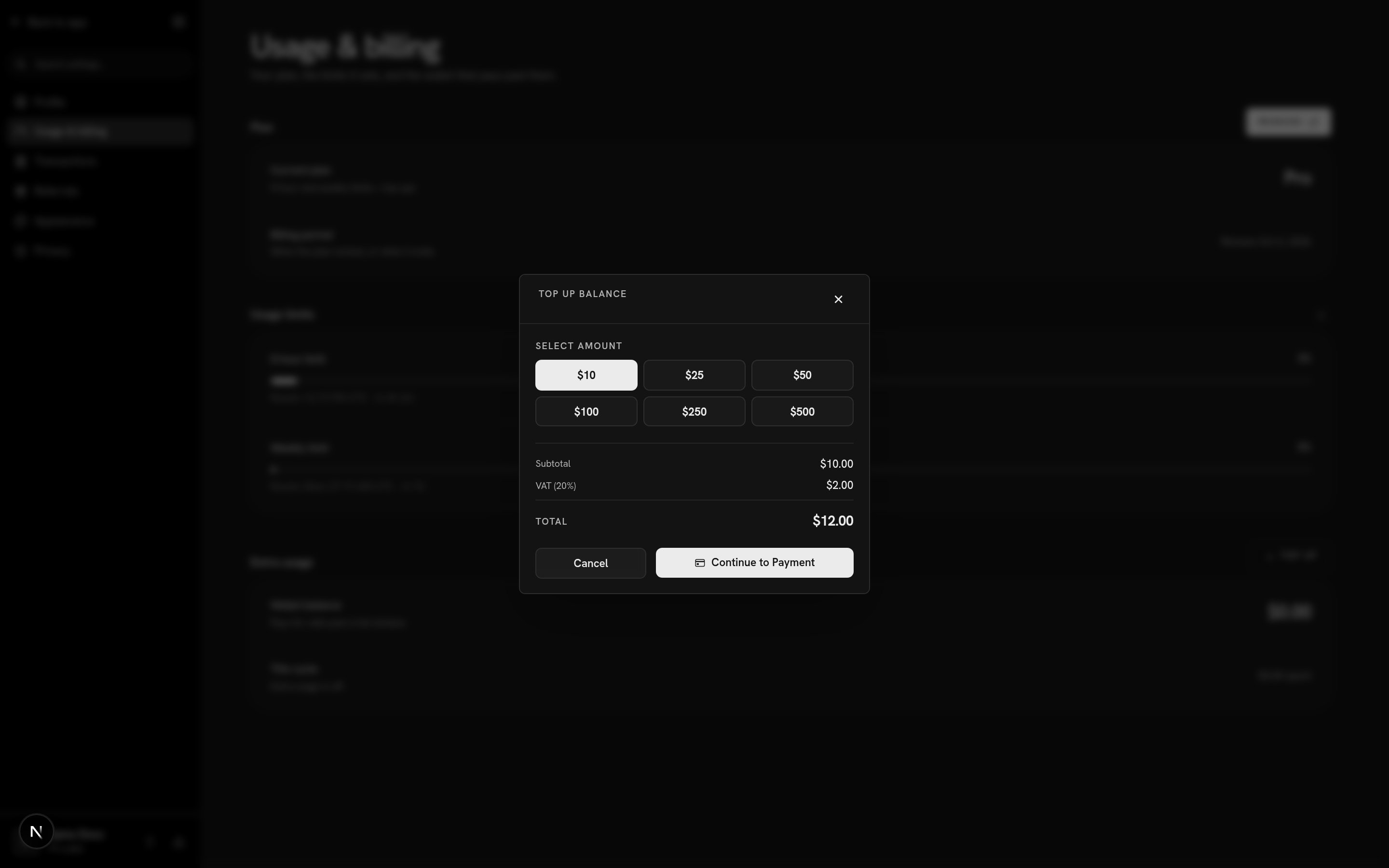
The top-up amounts, and the tax line before checkout
amount is in cents, so 1000 is the $10 preset. A valid request answers
{"checkout_url": "...", "session_id": "..."} and you send the person to the
URL. Only one checkout session is pending at a time: starting a new one expires
the last.
The dialog previews tax at a flat 20%. What you are actually charged is set by
Stripe Tax from the billing address on the account, so the total at checkout can
differ from the total in the preview. The figure the wallet is credited with is
the amount you picked, before tax.
403.
Running low
Two different things can be wrong with a wallet, and the product treats them differently. Low, not empty. Below 0.31). Top up to keep running harnesses.”* It is dismissible, and it comes back the next time the balance falls under the line. Free accounts never see it — there is no wallet behind it to act on. Nothing left. A call that needs the wallet and finds it under the threshold fails without_of_funds:
usage_window_exceeded — see Limits.
Where the spend is shown
Usage & billing shows two figures: the wallet balance, which leads because it is the number you act on, and$0.00 spent for the cycle underneath it.
Every individual charge and top-up is on Transactions:
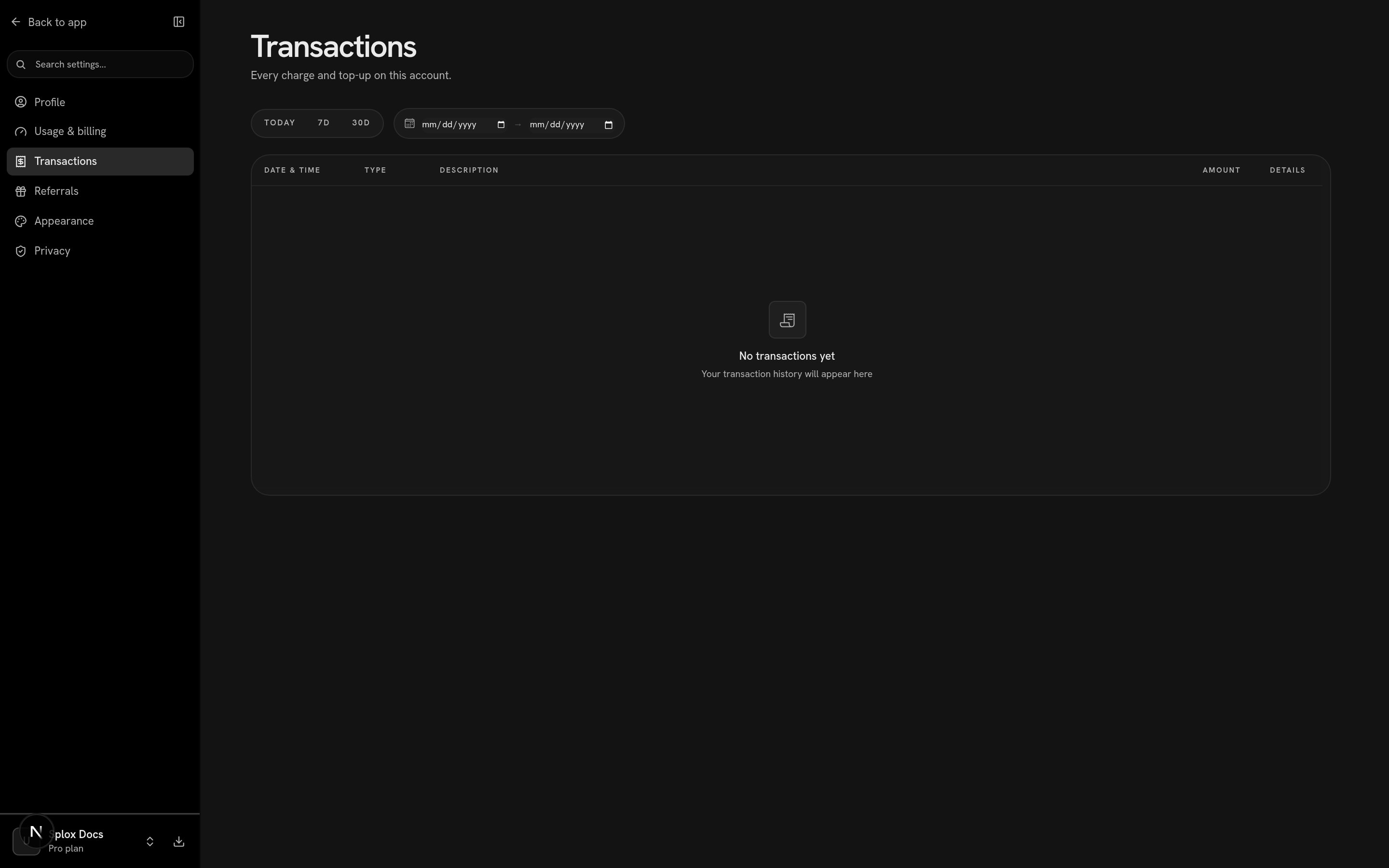
Transactions: every charge and top-up on the account
limit defaults to 20 and is capped at 100; page starts at 1. The default
range is the current calendar month — pass start_date and end_date as
YYYY-MM-DD to look further back, or the answer will be empty for reasons that
have nothing to do with the account.
This ledger is wallet movement, not invoices. Invoices and receipts for the
subscription itself live in the Stripe portal; Billing says
how to get there.
Usage
The windows the wallet pays past.
Billing
The subscription, invoices, and canceling.