> ## Documentation Index
> Fetch the complete documentation index at: https://docs.splox.io/llms.txt
> Use this file to discover all available pages before exploring further.
# Connections
> Connecting a server that needs an account, where the credential is kept, and how to take it back
Most MCP servers worth connecting want to know who you are. Splox holds that
credential for you: your harness never sees it, and neither does the agent. This
page is what happens between clicking **Connect** and having a working tool.
## Two kinds of authentication
A catalog entry declares which one it uses in `auth_type`.
You are sent to the provider, you approve the scopes there, and you come back
to Splox with a token it stores. The screen says it plainly: *"You will be
redirected to Linear to authorize access. We never see your password."*
The scopes are fixed by the catalog entry, not by you. Reddit's, for example:
```json theme={null}
"auth_config": {
"oauth_scopes": "identity read submit vote mysubreddits subscribe history edit"
}
```
Read that line before connecting. `submit` and `vote` are the ones that mean
an agent can post as you.
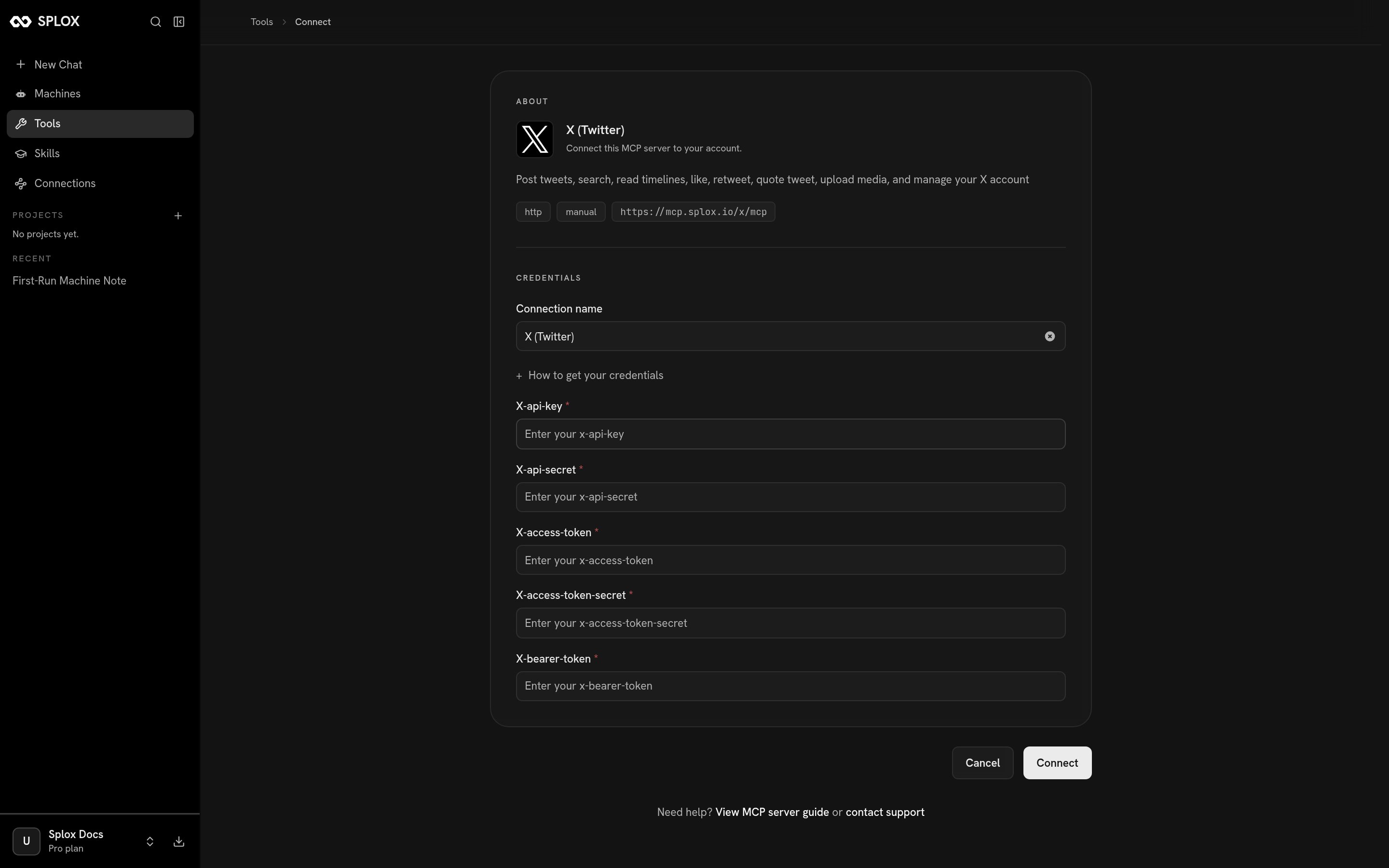
You paste keys into named fields. The names come from the entry, so they
match what the provider calls them — X asks for five:
```text theme={null}
X-api-key * X-api-secret *
X-access-token * X-access-token-secret *
X-bearer-token *
```
Entries that need a trip to a developer portal carry the instructions with
them, behind **How to get your credentials**.
 For a server of your own, "manual" means HTTP headers: you add
`Authorization: Bearer …` or `X-Api-Key: …` yourself in the
[Add MCP server](/tools/catalog#adding-a-server-that-is-not-in-the-catalog) form.
## Where the secret lives
With the platform, in one row per connection. The list endpoint the app calls
tells you *whether* there is a credential and *when it expires*, and never what
it is:
```json theme={null}
{
"servers": [
{
"id": "01a06134-991c-7fb2-a7ff-518d188c1608",
"name": "DeepWiki",
"url": "https://mcp.deepwiki.com/mcp",
"transport_type": "http",
"auth_type": "manual",
"has_credential": false,
"credential_expires_at": null,
"is_system": false
}
],
"total_count": 1
}
```
That is the whole security story, and it is short on purpose:
* The credential is attached to the **connection**, not to a harness or an agent.
Publishing a version, cloning a harness or handing it to somebody else moves no
secret.
* A run calls the tool; the platform attaches the credential on the way out. The
model is never shown it, so it cannot be leaked in a transcript or a
[run's events](/api/runs).
* Two accounts on the same provider are two connections with two names.
## Changing a credential
Click the connected server. The form comes back pre-filled with the name and
empty credential fields — *"Update your credentials below. Leave fields blank to
keep existing values."* Fill only what rotated and press **Update connection**.
## Revoking
The trash icon on the card removes the connection.
```bash theme={null}
curl -s -X DELETE "https:///api/v1/user-mcp-servers/01a06134-991c-7fb2-a7ff-518d188c1608" \
-H "Cookie: session=$SESSION"
```
```json theme={null}
{"message": "MCP server deleted successfully"}
```
It leaves your list immediately, and an agent whose `tools` entry names that uuid
is left with a source that has nothing behind it — so remove the entry from
`programs//main.py` too. Access you granted at the provider's own site is
revoked there, in the provider's settings; deleting the connection here does not
sign you out over there.
## Environment secrets
A different thing on a nearby screen. **Connections → Secrets** holds key/value
pairs that are injected as environment variables into your agent's sandbox — for
the agent and its sub-agents, in every chat.
For a server of your own, "manual" means HTTP headers: you add
`Authorization: Bearer …` or `X-Api-Key: …` yourself in the
[Add MCP server](/tools/catalog#adding-a-server-that-is-not-in-the-catalog) form.
## Where the secret lives
With the platform, in one row per connection. The list endpoint the app calls
tells you *whether* there is a credential and *when it expires*, and never what
it is:
```json theme={null}
{
"servers": [
{
"id": "01a06134-991c-7fb2-a7ff-518d188c1608",
"name": "DeepWiki",
"url": "https://mcp.deepwiki.com/mcp",
"transport_type": "http",
"auth_type": "manual",
"has_credential": false,
"credential_expires_at": null,
"is_system": false
}
],
"total_count": 1
}
```
That is the whole security story, and it is short on purpose:
* The credential is attached to the **connection**, not to a harness or an agent.
Publishing a version, cloning a harness or handing it to somebody else moves no
secret.
* A run calls the tool; the platform attaches the credential on the way out. The
model is never shown it, so it cannot be leaked in a transcript or a
[run's events](/api/runs).
* Two accounts on the same provider are two connections with two names.
## Changing a credential
Click the connected server. The form comes back pre-filled with the name and
empty credential fields — *"Update your credentials below. Leave fields blank to
keep existing values."* Fill only what rotated and press **Update connection**.
## Revoking
The trash icon on the card removes the connection.
```bash theme={null}
curl -s -X DELETE "https:///api/v1/user-mcp-servers/01a06134-991c-7fb2-a7ff-518d188c1608" \
-H "Cookie: session=$SESSION"
```
```json theme={null}
{"message": "MCP server deleted successfully"}
```
It leaves your list immediately, and an agent whose `tools` entry names that uuid
is left with a source that has nothing behind it — so remove the entry from
`programs//main.py` too. Access you granted at the provider's own site is
revoked there, in the provider's settings; deleting the connection here does not
sign you out over there.
## Environment secrets
A different thing on a nearby screen. **Connections → Secrets** holds key/value
pairs that are injected as environment variables into your agent's sandbox — for
the agent and its sub-agents, in every chat.
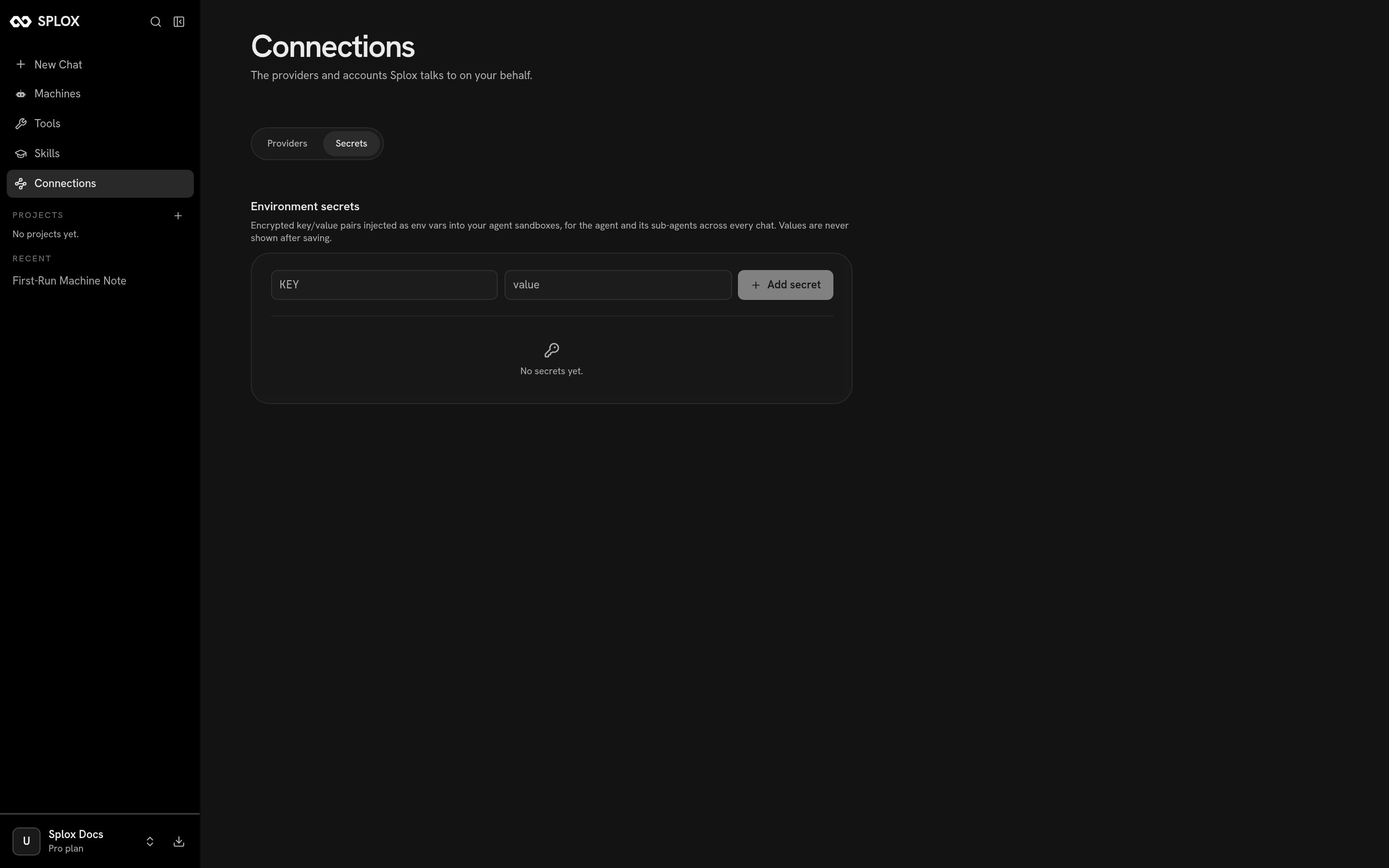 Use these for the credentials that are not an MCP server's: a bot token, an API
key your own [`tools/` file](/tools/custom) needs, anything a script on the
machine reads. The value is write-once — after saving, the screen shows the key
and not the value.
The agent is told the **names** and reads the values from the environment:
```python theme={null}
import os
token = os.environ["TELEGRAM_BOT_TOKEN"]
```
The key names travel to the agent in `~/tools/catalog.json` under `env_secrets`,
which is how a prompt can say "you have a Telegram token" without ever printing
one.
An environment variable is readable by anything running in that sandbox,
including a shell command the model writes. That is the trade for making it
usable from code. A secret that must never be in a sandbox belongs in an MCP
connection instead, where the platform attaches it outside the machine.
## Model providers
The **Providers** tab on the same screen is not about tools at all — it is where
you attach your own OpenAI, Anthropic, Gemini or ChatGPT account so agents can
run on it instead of on the platform's. See [Models](/concepts/model) and
[LLM endpoints](/api/llm-endpoints).
Use these for the credentials that are not an MCP server's: a bot token, an API
key your own [`tools/` file](/tools/custom) needs, anything a script on the
machine reads. The value is write-once — after saving, the screen shows the key
and not the value.
The agent is told the **names** and reads the values from the environment:
```python theme={null}
import os
token = os.environ["TELEGRAM_BOT_TOKEN"]
```
The key names travel to the agent in `~/tools/catalog.json` under `env_secrets`,
which is how a prompt can say "you have a Telegram token" without ever printing
one.
An environment variable is readable by anything running in that sandbox,
including a shell command the model writes. That is the trade for making it
usable from code. A secret that must never be in a sandbox belongs in an MCP
connection instead, where the platform attaches it outside the machine.
## Model providers
The **Providers** tab on the same screen is not about tools at all — it is where
you attach your own OpenAI, Anthropic, Gemini or ChatGPT account so agents can
run on it instead of on the platform's. See [Models](/concepts/model) and
[LLM endpoints](/api/llm-endpoints).