> ## Documentation Index
> Fetch the complete documentation index at: https://docs.splox.io/llms.txt
> Use this file to discover all available pages before exploring further.
# Models
> What "Harness decides" means, how a model gets chosen for a turn, and how to run on your own key
Every turn runs on one model, from one credential. Both are named by the agent
that is running:
```python theme={null}
assistant = agent(
"Assistant",
system_prompt="…",
model="kimi-k3",
provider="splox",
)
```
`model` is required. Alongside it an agent names exactly one of two things, and
neither is optional:
| Field | Means |
| ---------------------- | --------------------------------------------------------------------------------------------------------------- |
| `provider` | The platform's own credential for that provider. One of `anthropic`, `openai`, `gemini`, `openrouter`, `splox`. |
| `text_llm_endpoint_id` | One credential of your own, by the id of its endpoint. |
Naming both is refused rather than resolved: an agent that names a provider while
running on somebody else's credential lies to whoever reads it, and there is no
reading of it that bills the right account. Naming neither is refused too, in a
sentence saying which of the two to write. Both are checked when the run starts,
not at the moment `agent()` runs.
## "Harness decides" in the composer
The chip at the bottom right of the composer is the model for the messages you
send in this chat.
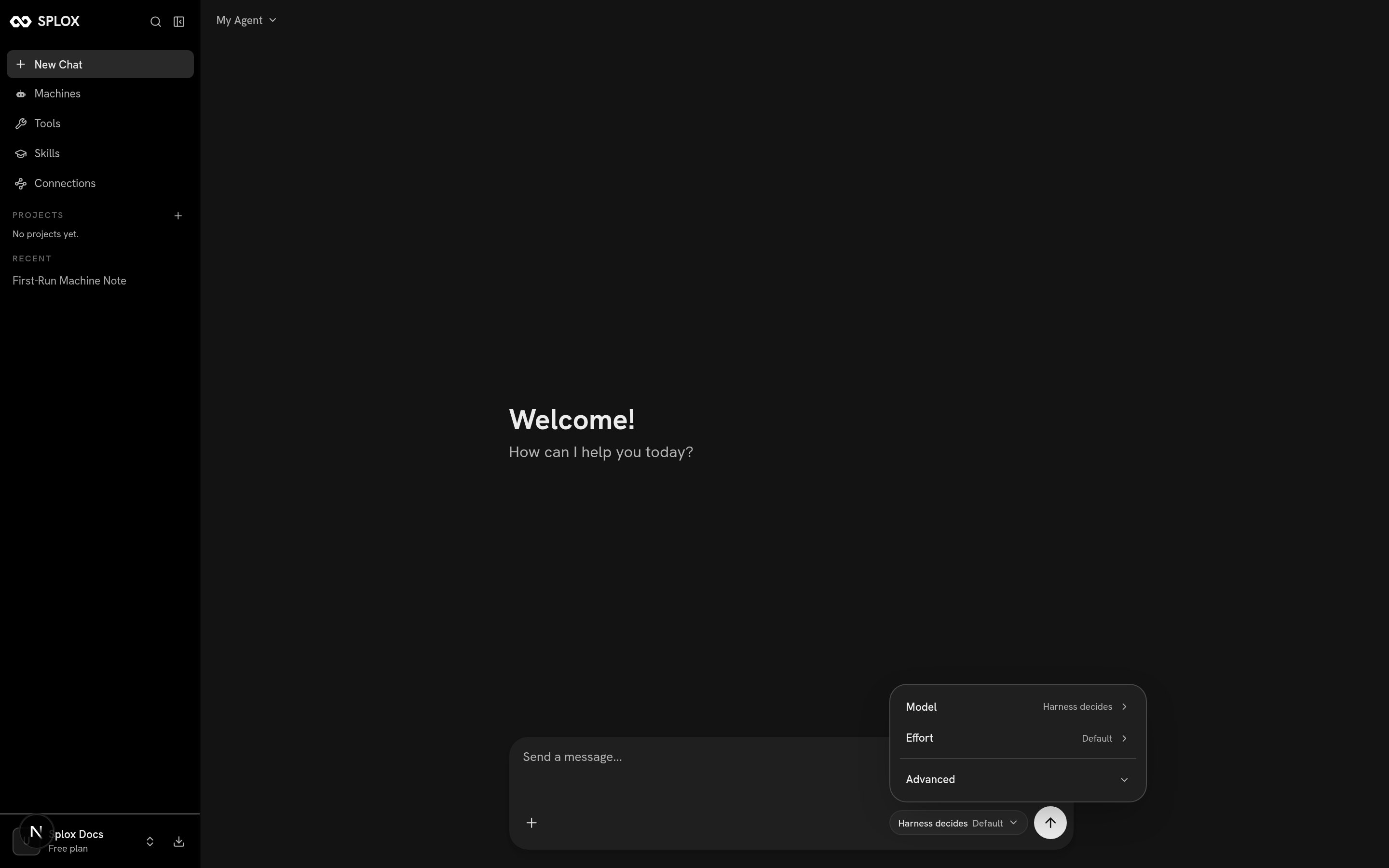 **Harness decides** is the default, and it means exactly what it says: no
selection is stored for this chat, so the model is the one the running agent
declared. Under the hood the chat's composer state carries `"selection": null`.
Open **Model** and you get the catalogue this account may use, with *Harness
decides* checked at the top:
**Harness decides** is the default, and it means exactly what it says: no
selection is stored for this chat, so the model is the one the running agent
declared. Under the hood the chat's composer state carries `"selection": null`.
Open **Model** and you get the catalogue this account may use, with *Harness
decides* checked at the top:
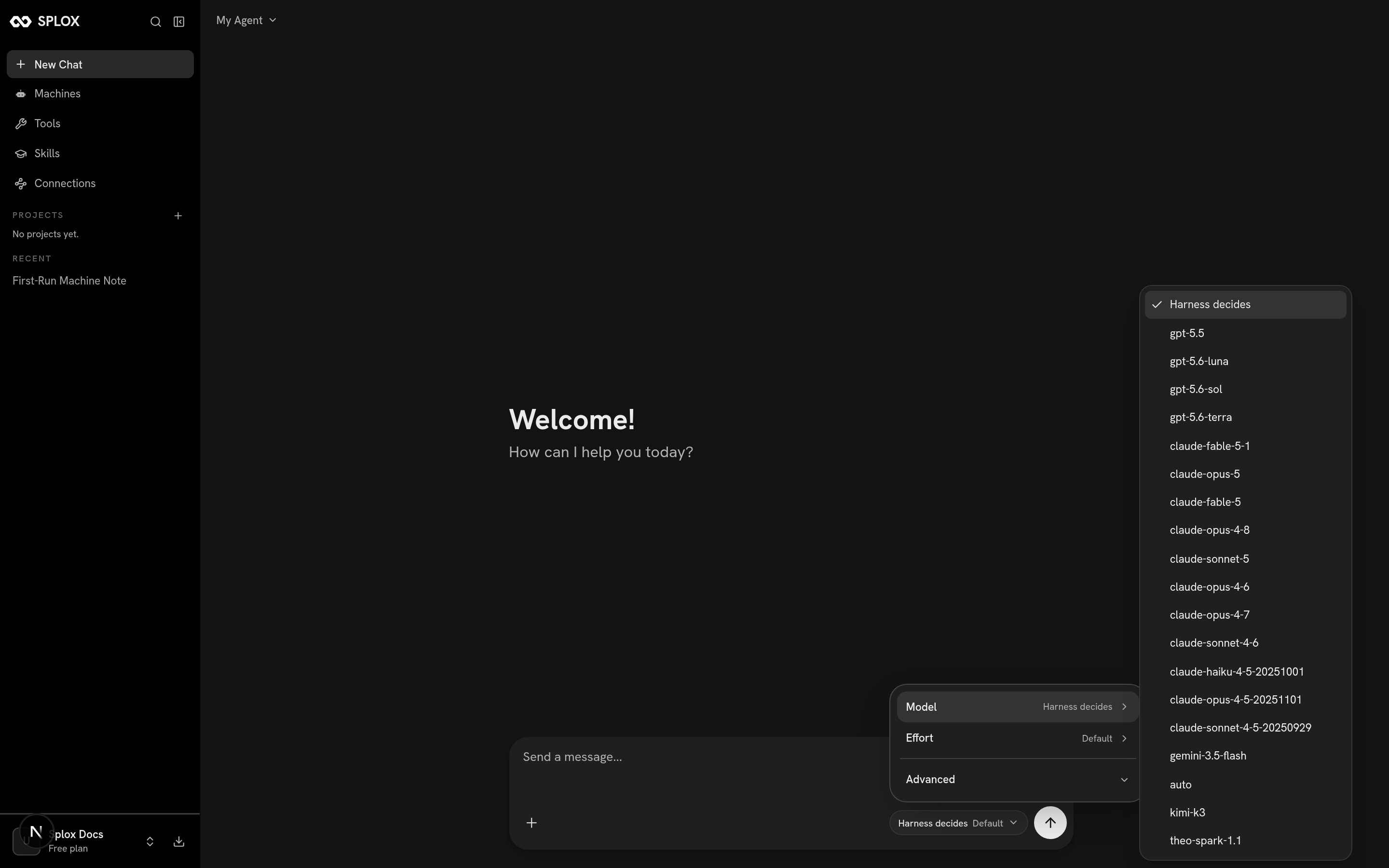 Picking one writes a selection against the chat — the endpoint and the model —
and picking *Harness decides* again clears it. Nothing about the harness changes
either way; the selection lives with the conversation.
## Effort
**Effort** is the reasoning ladder, and it only has rungs once a model is chosen:
with *Harness decides* the menu offers `Default` alone, because the ladder is a
property of the model and no model has been named yet.
Picking one writes a selection against the chat — the endpoint and the model —
and picking *Harness decides* again clears it. Nothing about the harness changes
either way; the selection lives with the conversation.
## Effort
**Effort** is the reasoning ladder, and it only has rungs once a model is chosen:
with *Harness decides* the menu offers `Default` alone, because the ladder is a
property of the model and no model has been named yet.
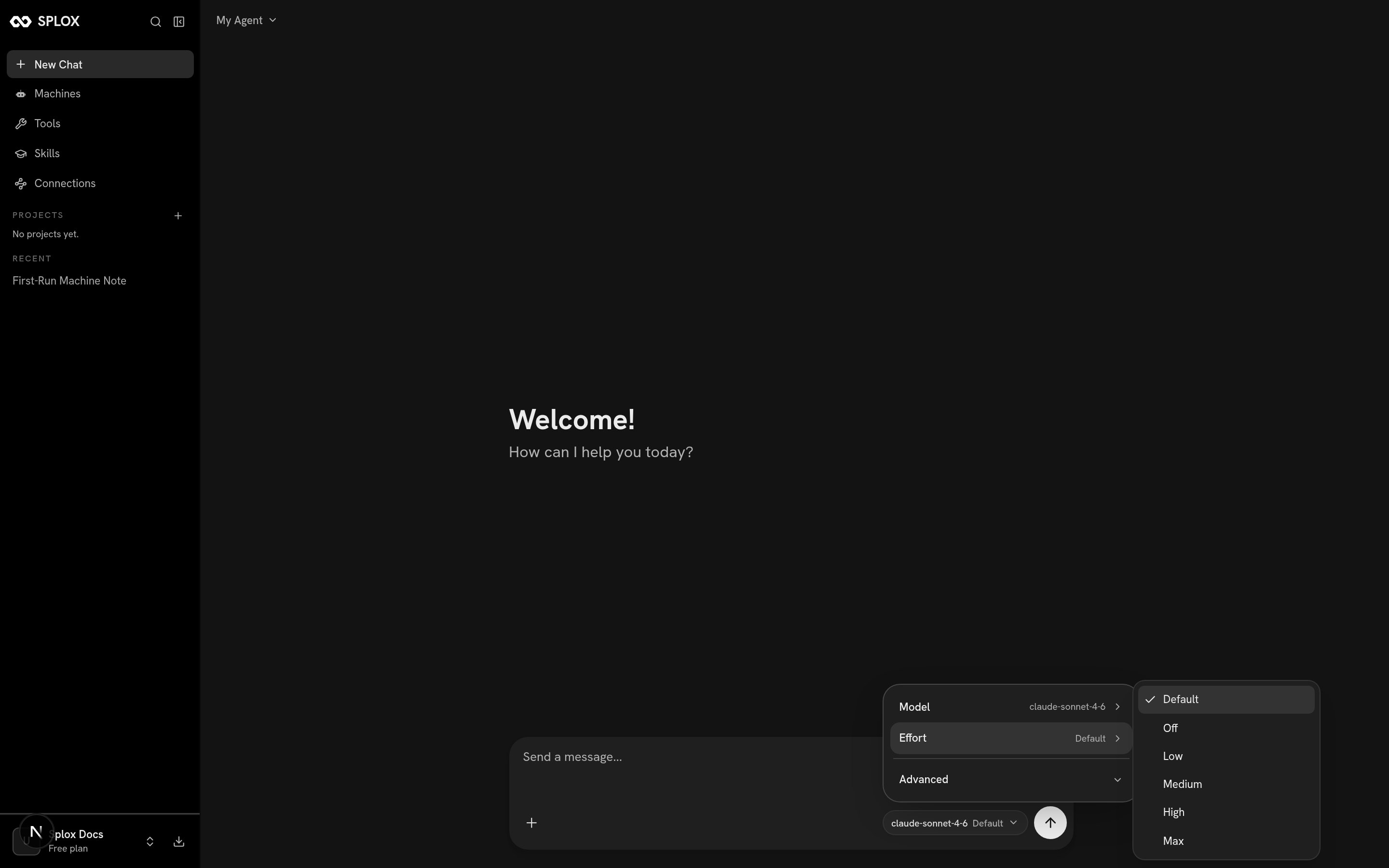 The rungs are `off`, `low`, `medium`, `high`, `max`, and each model advertises
which of them it has and which is its default. A model whose catalogue row has no
such rung refuses the turn rather than quietly running at another one. In a
harness the same idea is the agent's `reasoning=` field; both starter agents write
`reasoning="max"`.
## Choosing a model per turn
The declaration is the answer to "which model", asked once when the run starts.
`hooks/model.py` is the same question asked again on every turn:
```python programs/splox/hooks/model.py theme={null}
def choose(t):
return t.USE_DEFAULT
```
Answer a bare string to change the model alone, or an object to move the turn to
another provider — which is the only way a model name from a different vendor
means anything:
```python theme={null}
def choose(t):
if t.turn <= 3:
return {"model": "theo-spark-1.1", "provider": "splox"}
return t.USE_DEFAULT
```
The opening of a conversation is where the plan is made and where a wrong plan
costs the most, so it is the turn worth spending a slower model on. `model.choose`
runs after `context.build`, so it overrides a model a context named, and it is
only consulted when the hook actually returns a name. See [Hooks](/reference/hooks).
## Endpoints, and your own keys
An **endpoint** is a credential plus the base URL it talks to. Every account sees
the platform's own four:
| Endpoint | Provider slug | Auth |
| -------------------- | ------------- | -------- |
| Platform (OpenAI) | `openai` | platform |
| Platform (Anthropic) | `anthropic` | platform |
| Platform (Gemini) | `gemini` | platform |
| Platform (Splox) | `splox` | platform |
Writing `provider="anthropic"` on an agent is how you ask for the platform's
Anthropic credential; you never handle its key.
To run on your own, add it under **Connections** in the sidebar — *"Connect a
provider API key, ChatGPT account, or custom OpenAI-compatible endpoint"* — and
then name the endpoint on the agent by its id:
```python theme={null}
assistant = agent(
"Assistant",
system_prompt="…",
model="claude-sonnet-4-6",
text_llm_endpoint_id="019f455e-a84c-7d4c-87b0-c951d38bc224",
)
```
The OpenAI adapter takes any OpenAI-compatible base URL, which is what makes a
local model or a third-party gateway reachable the same way. List the endpoints an
account may use, and the models behind one, with
[`/v2/llm-endpoints`](/api/llm-endpoints).
The voice leg has its own two fields — `voice_llm_model` and
`voice_llm_endpoint_id` — used when an agent is invoked with a destination number.
Most authors leave them out and reuse one endpoint for both legs.
Every generation field: reasoning, output cap, temperature, caching, modalities.
Discovering the endpoints and models available to a key.
The rungs are `off`, `low`, `medium`, `high`, `max`, and each model advertises
which of them it has and which is its default. A model whose catalogue row has no
such rung refuses the turn rather than quietly running at another one. In a
harness the same idea is the agent's `reasoning=` field; both starter agents write
`reasoning="max"`.
## Choosing a model per turn
The declaration is the answer to "which model", asked once when the run starts.
`hooks/model.py` is the same question asked again on every turn:
```python programs/splox/hooks/model.py theme={null}
def choose(t):
return t.USE_DEFAULT
```
Answer a bare string to change the model alone, or an object to move the turn to
another provider — which is the only way a model name from a different vendor
means anything:
```python theme={null}
def choose(t):
if t.turn <= 3:
return {"model": "theo-spark-1.1", "provider": "splox"}
return t.USE_DEFAULT
```
The opening of a conversation is where the plan is made and where a wrong plan
costs the most, so it is the turn worth spending a slower model on. `model.choose`
runs after `context.build`, so it overrides a model a context named, and it is
only consulted when the hook actually returns a name. See [Hooks](/reference/hooks).
## Endpoints, and your own keys
An **endpoint** is a credential plus the base URL it talks to. Every account sees
the platform's own four:
| Endpoint | Provider slug | Auth |
| -------------------- | ------------- | -------- |
| Platform (OpenAI) | `openai` | platform |
| Platform (Anthropic) | `anthropic` | platform |
| Platform (Gemini) | `gemini` | platform |
| Platform (Splox) | `splox` | platform |
Writing `provider="anthropic"` on an agent is how you ask for the platform's
Anthropic credential; you never handle its key.
To run on your own, add it under **Connections** in the sidebar — *"Connect a
provider API key, ChatGPT account, or custom OpenAI-compatible endpoint"* — and
then name the endpoint on the agent by its id:
```python theme={null}
assistant = agent(
"Assistant",
system_prompt="…",
model="claude-sonnet-4-6",
text_llm_endpoint_id="019f455e-a84c-7d4c-87b0-c951d38bc224",
)
```
The OpenAI adapter takes any OpenAI-compatible base URL, which is what makes a
local model or a third-party gateway reachable the same way. List the endpoints an
account may use, and the models behind one, with
[`/v2/llm-endpoints`](/api/llm-endpoints).
The voice leg has its own two fields — `voice_llm_model` and
`voice_llm_endpoint_id` — used when an agent is invoked with a destination number.
Most authors leave them out and reuse one endpoint for both legs.
Every generation field: reasoning, output cap, temperature, caching, modalities.
Discovering the endpoints and models available to a key.