> ## Documentation Index
> Fetch the complete documentation index at: https://docs.splox.io/llms.txt
> Use this file to discover all available pages before exploring further.
# Skills
> The skills your agents can pick up, the ones that ship, and how one gets attached
A skill is a folder with a `SKILL.md` in it — instructions the agent reads when a
task calls for them, and files beside it that cost nothing until they are opened.
The **Skills** screen is the library those folders live in.
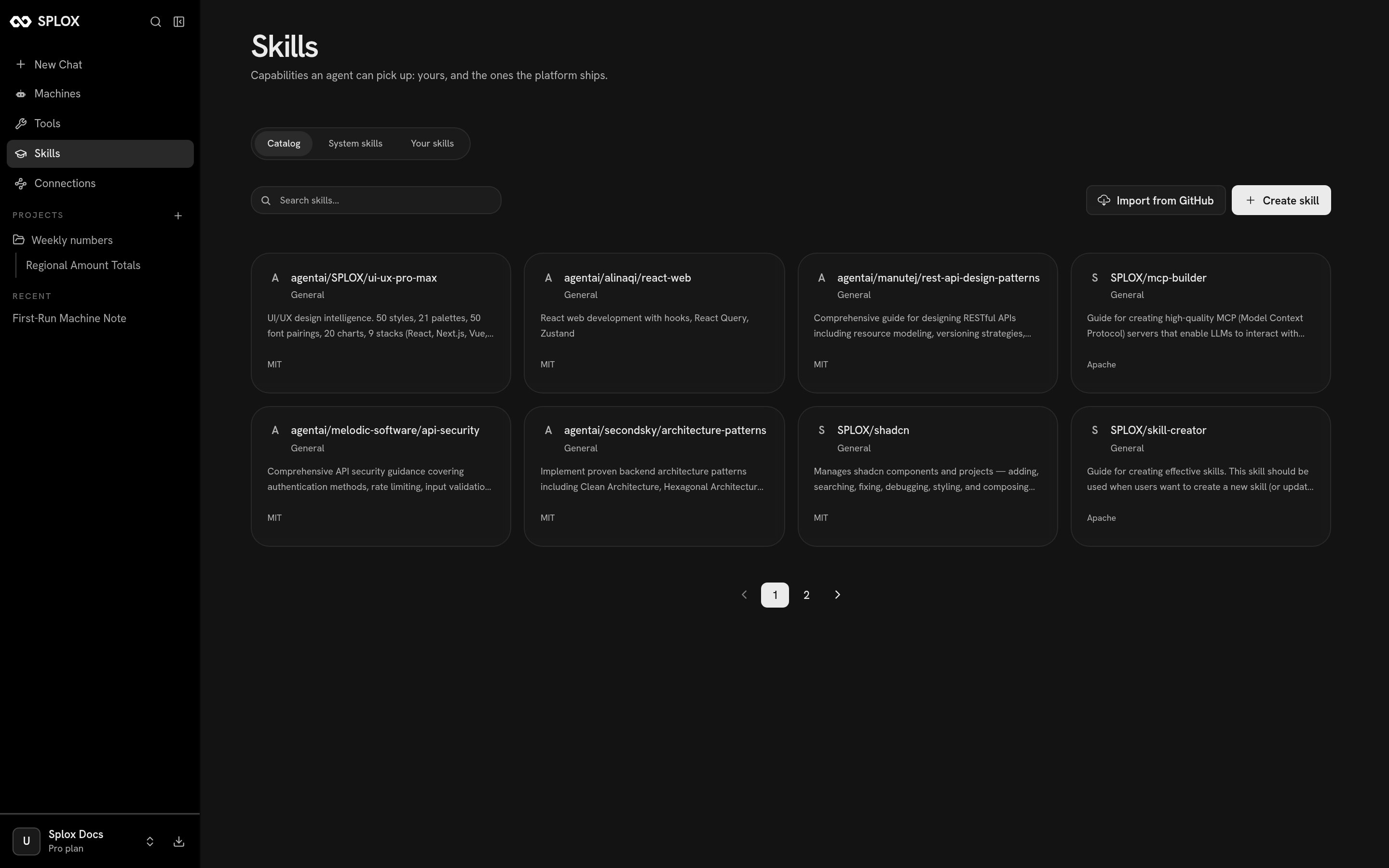 Three tabs: **Catalog** is what you can copy, **System skills** is what the
platform ships, **Your skills** is what you own.
## What ships
Three tabs: **Catalog** is what you can copy, **System skills** is what the
platform ships, **Your skills** is what you own.
## What ships
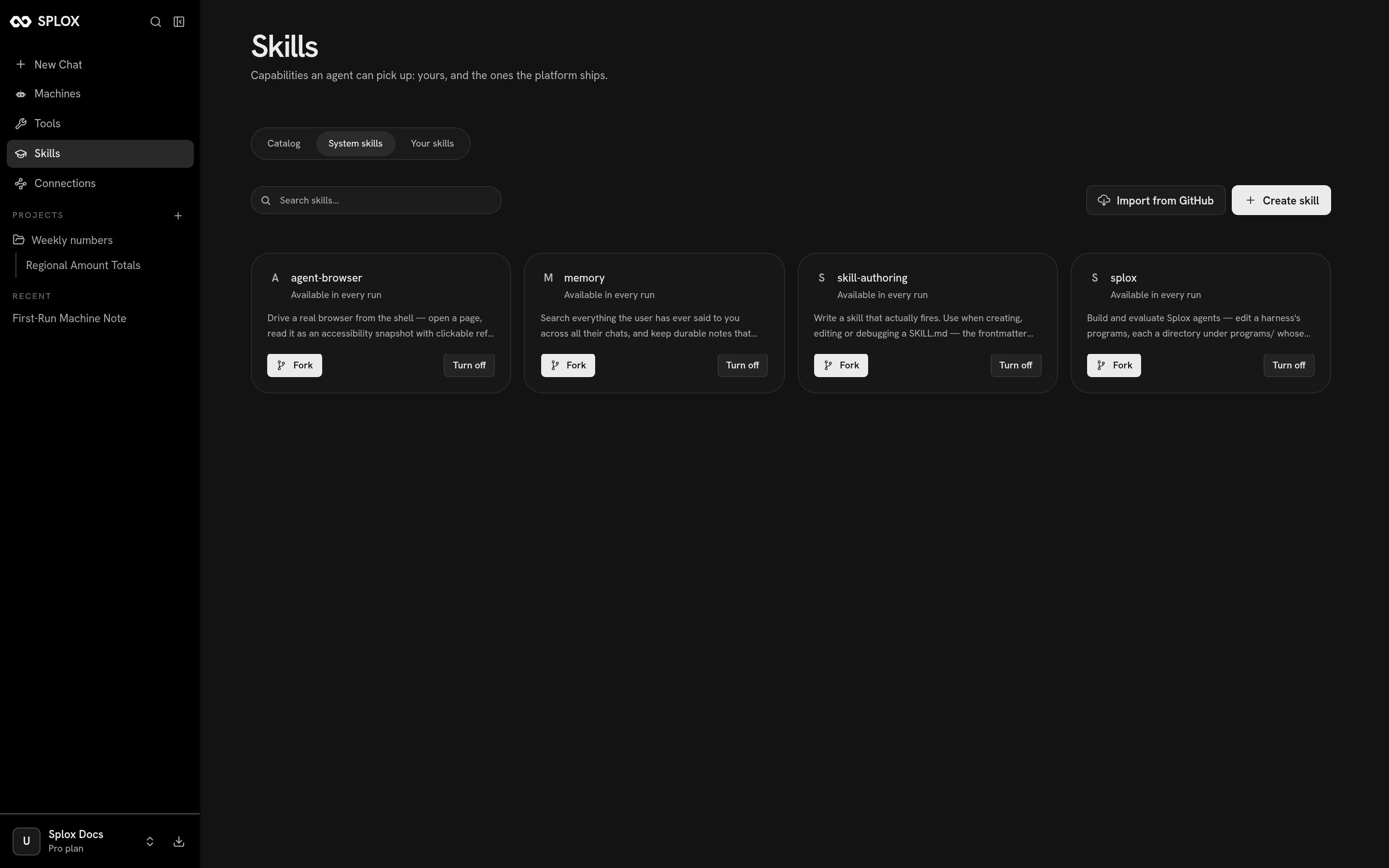 | Skill | What it teaches |
| ----------------- | -------------------------------------------------------------------------------------------------------------------------------------------- |
| `agent-browser` | Driving a real browser: reading a page as an accessibility snapshot, clicking and filling, and what to do about bot protection and captchas. |
| `memory` | Searching everything the user has said across all their chats, and keeping notes that survive the conversation. |
| `skill-authoring` | Writing a skill that actually fires: the frontmatter rules and how a description gets a skill selected. |
| `splox` | Building on Splox itself: editing a harness's programs, hooks and tools, and running evals against a version. |
Each has **Fork** — take a copy into your own library and change it — and **Turn
off**.
## Getting one from the catalog
Click a card and you get the skill's own files, read-only, with its license:
| Skill | What it teaches |
| ----------------- | -------------------------------------------------------------------------------------------------------------------------------------------- |
| `agent-browser` | Driving a real browser: reading a page as an accessibility snapshot, clicking and filling, and what to do about bot protection and captchas. |
| `memory` | Searching everything the user has said across all their chats, and keeping notes that survive the conversation. |
| `skill-authoring` | Writing a skill that actually fires: the frontmatter rules and how a description gets a skill selected. |
| `splox` | Building on Splox itself: editing a harness's programs, hooks and tools, and running evals against a version. |
Each has **Fork** — take a copy into your own library and change it — and **Turn
off**.
## Getting one from the catalog
Click a card and you get the skill's own files, read-only, with its license:
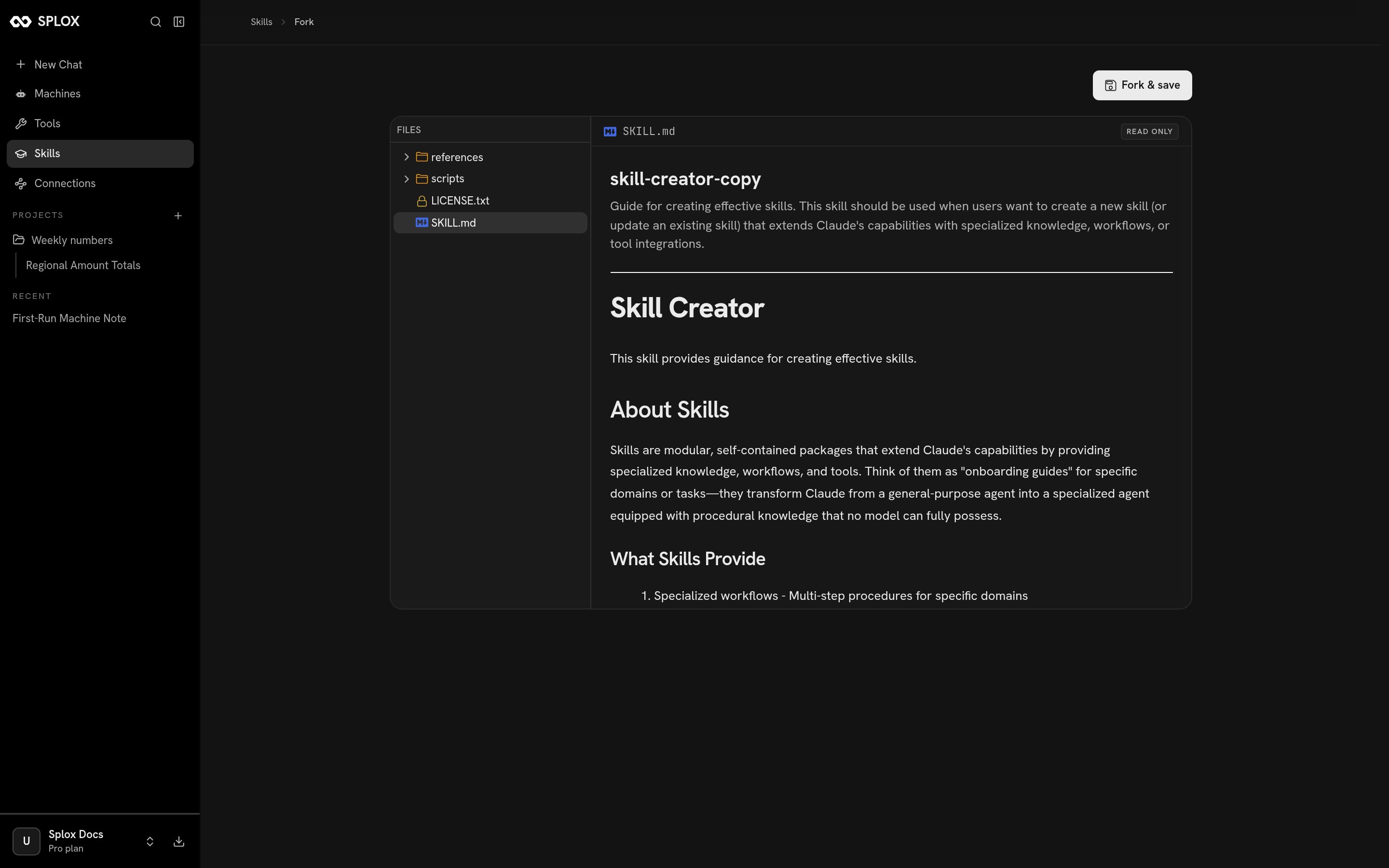 **Fork & save** copies it into **Your skills** under a name of your own — it
proposes `-copy` — and from then on it is a file you can edit.
Two other ways to fill that tab:
* **Create skill** opens an editor on a fresh `SKILL.md`, with the frontmatter
and the headings already in place.
* **Import from GitHub** takes a link to a skill folder in any public
repository, or a directory holding several of them, and pulls them in.
## Attaching one to an agent
Skills are attached in code, in the agent's declaration:
```python theme={null}
assistant = agent(
"Assistant",
system_prompt=prompt("assistant"),
tools=["system:compute"],
skills=["system:memory", "system:agent-browser", "trading-desk"],
)
```
`system:` is one of the platform's; a bare name is one of yours. Every
skill is listed by name and there is no wildcard, so an agent has the skills its
line names and no others.
The library's files are in the sandbox either way, at `~/skills`. The `skills=`
list is what the agent is **told** it has — the name and the description sit in
its context, and the body is read when the skill fires. That is the whole trick:
a harness can carry a hundred pages of procedure and pay for a line of it per
turn.
What goes in SKILL.md, what goes beside it, and when a skill beats a prompt.
Everything else an agent declaration carries.
**Fork & save** copies it into **Your skills** under a name of your own — it
proposes `-copy` — and from then on it is a file you can edit.
Two other ways to fill that tab:
* **Create skill** opens an editor on a fresh `SKILL.md`, with the frontmatter
and the headings already in place.
* **Import from GitHub** takes a link to a skill folder in any public
repository, or a directory holding several of them, and pulls them in.
## Attaching one to an agent
Skills are attached in code, in the agent's declaration:
```python theme={null}
assistant = agent(
"Assistant",
system_prompt=prompt("assistant"),
tools=["system:compute"],
skills=["system:memory", "system:agent-browser", "trading-desk"],
)
```
`system:` is one of the platform's; a bare name is one of yours. Every
skill is listed by name and there is no wildcard, so an agent has the skills its
line names and no others.
The library's files are in the sandbox either way, at `~/skills`. The `skills=`
list is what the agent is **told** it has — the name and the description sit in
its context, and the body is read when the skill fires. That is the whole trick:
a harness can carry a hundred pages of procedure and pay for a line of it per
turn.
What goes in SKILL.md, what goes beside it, and when a skill beats a prompt.
Everything else an agent declaration carries.